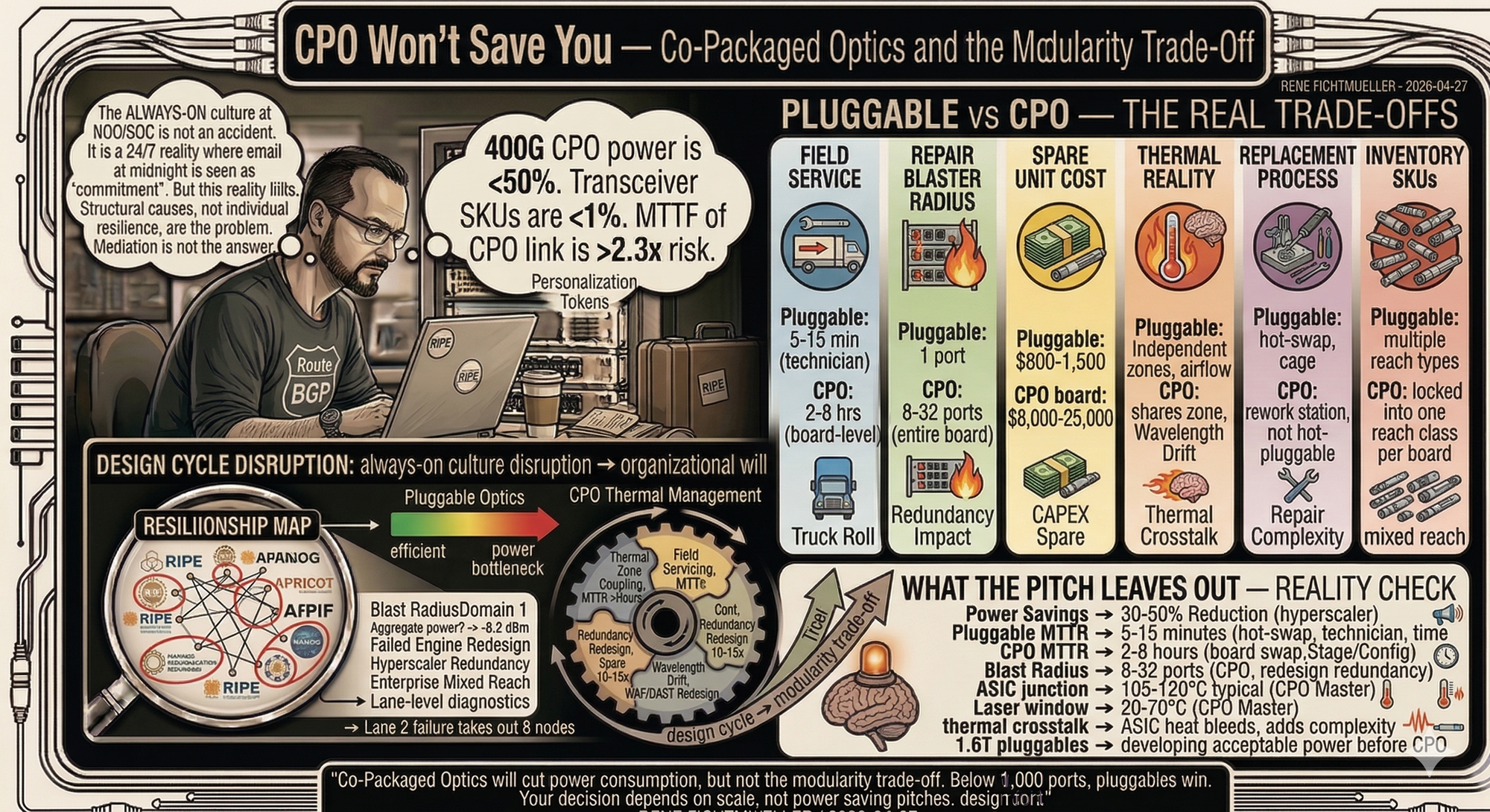
CPO Won't Save You — Co-Packaged Optics and the Modularity Trade-Off
Co-Packaged Optics will cut power consumption in half. CPO will eliminate transceiver inventory headaches. CPO will redefine data center design. You have heard the pitch. The pitch skips the parts that matter.
Traditional pluggable optics sit in a front-panel cage. Light leaves the module, travels through fiber, arrives at another module. Electrical signals move from the module into the switch ASIC across a PCB trace. That trace burns power. At 800G and above, the electrical path between ASIC and optic becomes the bottleneck.
CPO moves the optical engine onto the switch package itself. Photonic chiplets sit next to the ASIC on the same substrate. Electrical signals travel millimeters instead of centimeters. The SerDes power drops because the channel is shorter and cleaner.
CPO Photonic chiplet on ASIC package → interposer (2–5 mm) → ASIC
Electrical path power Pluggable: 8–15 pJ/bit | CPO: 2–5 pJ/bit
SerDes complexity Pluggable: full retimer | CPO: simplified driver
Thermal coupling CPO: optic shares thermal zone with ASIC (100W+ neighbor)
Field replacement CPO: board swap or rework station. Not hot-pluggable.
The power savings are real. Broadcom, Intel, and Ayar Labs have published numbers showing 30–50% reduction in per-link power at 800G and beyond. For a hyperscaler running 100,000 links, that translates to megawatts of saved cooling and power distribution.
A pluggable module fails. A technician walks to the rack, pulls the module, inserts a new one. Five minutes. The switch stays online.
A CPO engine fails. The entire switch board goes offline. Depending on the integration level, you replace the line card or the entire chassis. Sparing strategy shifts from stocking $1,200 optics to stocking $15,000 line cards. Repair time shifts from minutes to hours, sometimes days if the replacement board needs staging and configuration.
CPO MTTR 2–8 hours (board swap + config restore)
Spare unit cost Pluggable: $800–$1,500 | CPO board: $8,000–$25,000
Spare inventory footprint CPO: fewer SKUs but higher capital per spare
Failure blast radius Pluggable: 1 port | CPO: 8–32 ports per engine
Truck roll risk CPO: board-level swap may require vendor technician
A single CPO engine failure takes out 8 to 32 ports at once. Your redundancy design needs to absorb that. If you planned for single-port failures, CPO forces a redesign of your failure domains.
Switch ASICs run hot. A Memory 51.2T ASIC dissipates 300–500W. CPO places photonic components millimeters from that heat source.
Lasers and modulators are temperature-sensitive. Laser wavelength drifts 0.1 nm per degree Celsius. Silicon photonic ring resonators shift resonance with temperature. The thermal management system now serves two masters: keep the ASIC below throttling temperature and keep the optics within their operating window.
Laser operating range 20–70°C (performance degrades above 55°C)
Thermal crosstalk ASIC heat bleeds into photonic chiplet zone
Cooling approach Active cooling / thermal isolation required
Pluggable thermal Independent thermal zone, airflow over cage
Pluggables have a natural advantage: they sit in their own thermal zone. Airflow passes directly over the module. CPO requires precision thermal engineering that adds cost and complexity to every board revision.
Hyperscalers building 100,000-port fabrics with a single optics SKU and dedicated thermal engineering teams: CPO makes sense. The power savings at scale justify the R&D investment and the operational model change.
Enterprise data centers running 500 to 5,000 ports with mixed optics types across multiple reach categories: pluggables win. You need DR4 for one link, FR4 for another, and ZR+ for your DCI connections. CPO locks you into one reach class per board.
Pluggable sweet spot Enterprise, mixed reach, multi-vendor, field service
CPO timeline Limited production 2026, volume 2028+
Pluggable roadmap 800G shipping, 1.6T pluggables in development
Key question Can 1.6T pluggables close the power gap before CPO scales?
1.6T pluggable optics are in development. If vendors deliver them with acceptable power envelopes before CPO reaches volume production, the business case for CPO narrows to the largest deployments.
Your decision depends on scale. Below 10,000 ports, the operational flexibility of pluggables outweighs the power savings of CPO. Above that threshold, run the numbers on power cost over five years. The answer might surprise you in both directions.