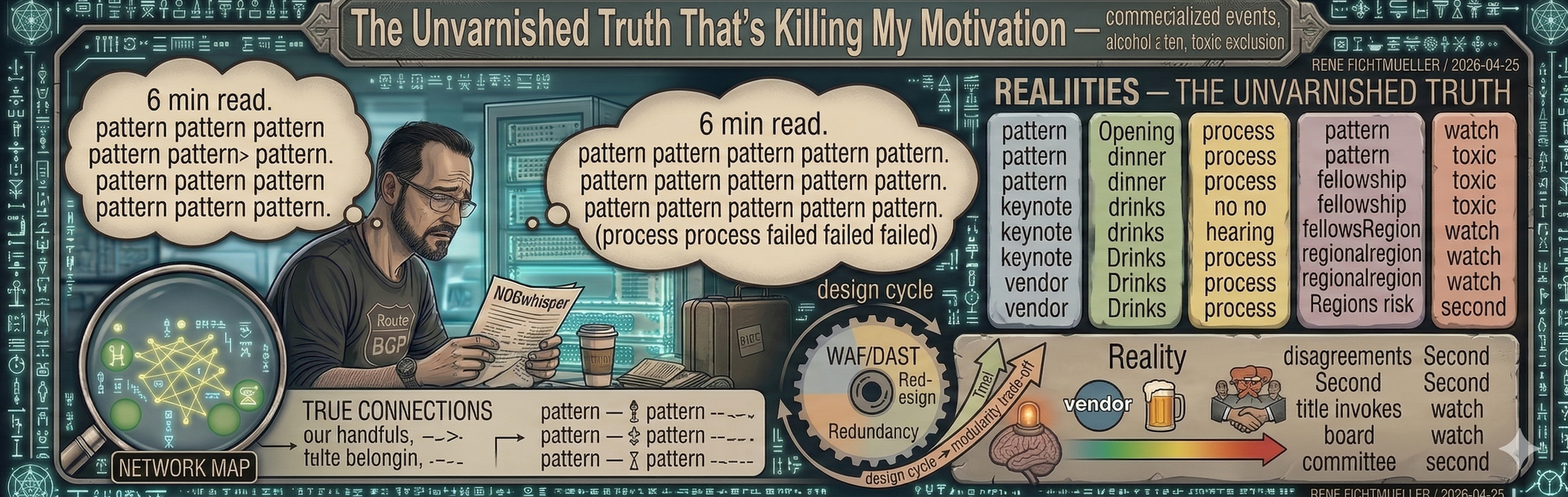
The Unvarnished Truth That's Killing My Motivation
Commercialized events. Alcohol at ten in the morning. Being excluded from a conference without anyone asking my side. The NOG circuit gave me some of the best relationships of my career. It also gave me this.
Fair warning: this is a typical Rene trigger post — straight from the heart. This is my personal opinion.
I know this post crosses a line. There are things in this community that get discussed privately — at hotel bars, in DMs, in calls between people who actually trust each other — but never publicly. Not on a mailing list. Not on a stage. Not where it might actually matter. I've watched that silence protect the wrong things for long enough. So here's my version of saying it out loud. Some people will recognize themselves in it. Most of them probably won't enjoy that.
Let me start with something I'm not supposed to say out loud at a peering forum: I've left NOG meetings feeling like a milking cow.
Not every time. Not every event. But enough times, and with increasing frequency, that the pattern is impossible to ignore. The sponsor package email arrives six months before the event. Then the reminder. Then the "last chance for gold tier." You arrive, and the most prominent signage isn't the session schedule — it's the vendor banners. The networking breaks are sponsored. The lanyards are sponsored. The wifi password is a vendor's product name. And somewhere in the program, squeezed between two keynote slots that are essentially sales presentations with slides, there are the actual operational talks that are the reason anyone showed up.
I understand the economics. Events cost money. Venues cost money. The alternative to sponsorship is registration fees high enough to price out exactly the people who should be in the room. I'm not arguing for burning the sponsor model down.
I'm arguing that somewhere between "this event is financially sustainable" and "this event is optimized for sponsor ROI," the community soul of a NOG meeting quietly leaves the building.
Everyone wants to travel. Everyone performs the travel. "I'm going to this one, then that one, then six weeks later that other one." The passport stamps, the hotel loyalty points, the ability to say you've been to thirty-something countries on the conference circuit. It sounds glamorous from the outside. From the inside, after enough years of it, it looks different.
A week of conference plus travel means: one week away from your family. One week away from your actual projects. One week of being "on" — followed by flying home, and then the work really starts. Because accounting wants the expense report. The follow-up emails didn't write themselves. The things you deferred to get on the plane are still waiting.
Nobody talks about that part. The conference ends, the photos go up, the LinkedIn post goes out, and then at home you're decompressing for three days from something that was supposed to be professionally valuable and also exhausting and also expensive in ways the expense report doesn't capture.
I've been sober since the beginning of December. Directly after MENOG. That timing wasn't coincidental.
Alcohol is the connective tissue of the conference social circuit in a way that I don't think the industry has reckoned with honestly. Drinks at the opening reception. Drinks at the sponsored dinner. Drinks at the unofficial after-party. Drinks, for some people, starting noticeably early the next morning. I've watched people at ten o'clock in the morning, at a professional technical conference, already on their second drink — and watched everyone around them treat it as completely normal, because within the bubble of the event, it is normal.
The thing about that normalization is that it hides something. There are people on this circuit who do not function well without alcohol. That's not a judgment — it's an observation, and one that the community's social structure actively obscures because the social structure is built around drinking. If you have a problem, the conference circuit is a very good place to not notice it for a long time.
I stopped because after a week of events, I want to come home and be present. For my family. For my work. I feel better. I find alcohol genuinely repulsive now in a way I didn't expect. And what I notice, looking at the circuit from outside the drinking culture for the first time in years, is how much of the social architecture is built around something a significant number of people can't actually opt out of without opting out of the social circuit entirely.
That's worth naming.
There are people in this community who wear their board positions the way some people wear expensive watches — not to tell the time, but to make sure you've noticed they can afford one.
You see it most clearly when someone disagrees with them, or simply doesn't immediately defer. The title materializes. The committee membership surfaces. Years of service get invoked. What was a conversation about routing policy becomes, subtly, a conversation about who outranks whom. The LinkedIn headline has entered the chat, uninvited, as a rhetorical device.
I've learned to recognize the tell: the moment someone mentions their position in a sentence that didn't require it, the actual discussion has ended and the status negotiation has begun. Usually somewhere around the second drink — which, see previous section, is itself a data point.
To be clear: plenty of people carry real institutional knowledge and genuine authority in this community and never need to mention their titles at all. They're easy to identify because they answer questions without first establishing that you should feel privileged to receive an answer. The others are also easy to identify, for different reasons.
I have ADHD and an impulse control disorder. I know this about myself. I manage it as well as I can. At a conference a few years ago, I told someone to leave me alone. Multiple times — four, maybe six — because they weren't hearing it the first time. I mentioned my ADHD. I mentioned the impulse control. I tried to explain why I needed the interaction to end.
The next day, I was excluded from the conference. Without anyone asking for my side. Without a conversation. Without a process. Someone decided, and the decision was implemented, and I was told. That's not professional; in my opinion, that's toxic behavior.
What bothered me — and I want to be precise — wasn't the outcome. It was the complete absence of process. One side of an incident, one decision, no hearing. A code of conduct that only applies in one direction, or that gets enforced based on who has the louder voice or the more prominent position, is not a code of conduct. It's a social hierarchy with extra steps and a nicer font.
I still think about it. Not out of bitterness — genuinely, I'm not. But because it illustrated something about how accountability actually functions here, versus how we say it functions.
Out of everyone I've met across years on this circuit — and it's a lot of people, on a lot of continents — there are maybe four handfuls I'd call actual friends. My test: would they pick me up from the airport on a day when I didn't ask and they had something else to do?
Hernan would. Has. Paul, Dave, Terry, Bayar, Tashi, Gogo — yes. A few more. Not many more.
What those friendships look like in practice: I have a day off somewhere, far from home, somewhere past the hundred-day mark on the road. One of them calls. Ten minutes. No agenda. "What are you doing today?" And then they show me their city — not the conference hotel district, not the tourist circuit. Their neighbourhood. Their favourite place for lunch. The part of the country they're proud of that nobody photographs. The culture, real and unglamourized.
There's a German word — Geborgenheit — that doesn't translate cleanly. It's the feeling of being safe, of belonging, of being held somewhere you trust. After a hundred days on the road, checking into another hotel in another city for another event, that's what those friendships give me. Not a networking opportunity. Not a warm lead. A second home and a moment that has nothing to do with the next sponsoring.
That's what the NOG community produces at its best. Not the lanyards.
Fellowship programs are the most direct investment the NOG community can make in the people who need these events most. Engineers from remote locations. Women in network operations. LGBTQ+ engineers in regions where being out at a professional event carries real personal risk. People of colour in a field where the conference stage doesn't remotely reflect the actual workforce. People running critical national infrastructure in markets where vendor relationships don't come with a complimentary conference seat.
But fellowship programs exist inside the same events I've been describing. Events with alcohol at ten in the morning. Events where accountability processes fail the people they're supposed to protect. Events where social architecture defaults to the most connected, the most vocal, the most titled.
Bringing more people into that — without fixing the underlying dynamics — is not progress. It's exposure.
The people we're trying to bring in deserve both the knowledge transfer and the safety to actually benefit from it. The Geborgenheit. Not just the lanyard.
That's not an unreasonable thing to want. And it doesn't happen by default.
Hopefully 2026 will show that some of it can change. That some of it will. I'd genuinely like to be wrong about how entrenched this is. I've been coming to these events long enough to have seen this community at its best. I know what it's capable of when it actually tries.