Open Line Systems — Breaking the DWDM Vendor Lock
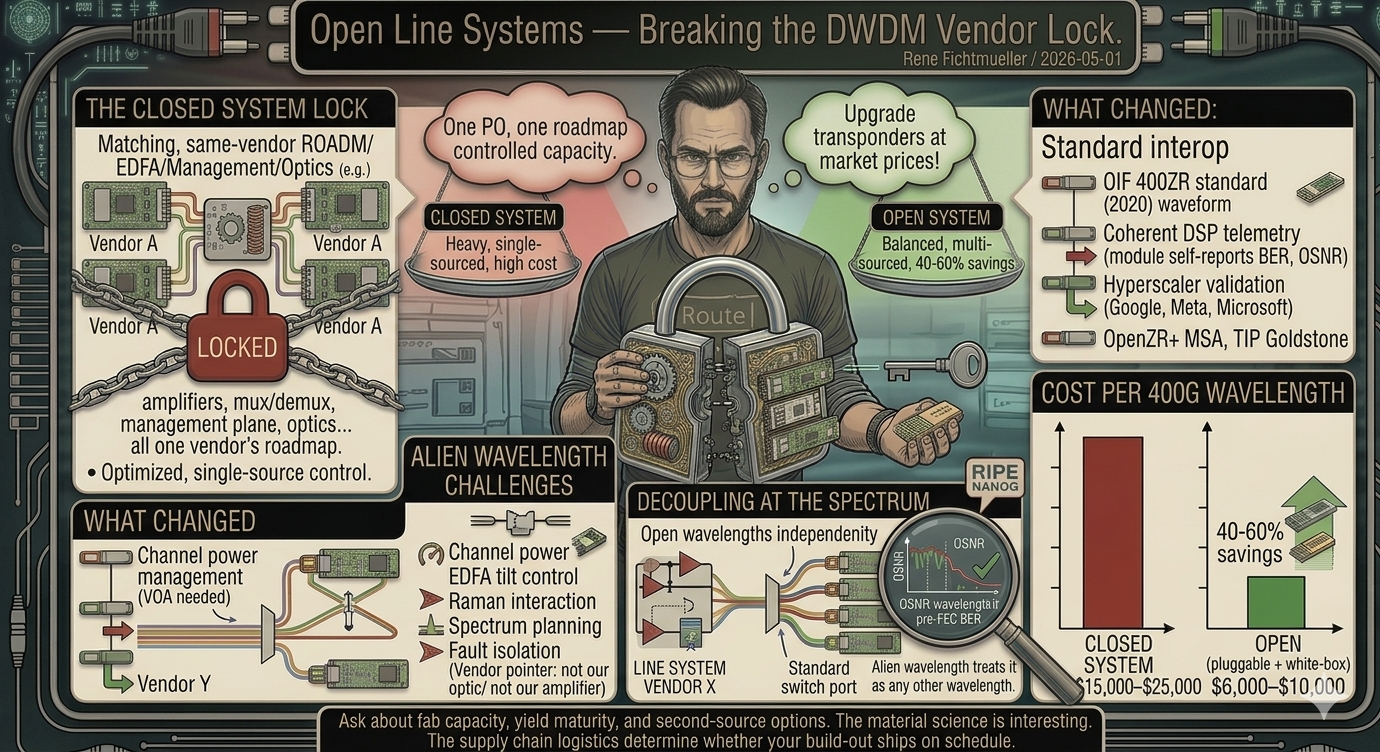
Your DWDM line system and your transponders come from the same vendor. The amplifiers, the mux/demux, the management plane, the optics. One PO, one support contract, one vendor's roadmap controlling your capacity timeline.
Open Line Systems break that coupling. And the vendors who sell closed systems would prefer you didn't know it works.
A DWDM line system has three jobs: amplify optical signals across a span, multiplex multiple wavelengths onto a single fiber, and monitor channel power and OSNR. The transponder (or pluggable coherent optic) generates the wavelength. The line system carries it.
ROADM (WSS) Wavelength switching — add, drop, pass-through
Mux/Demux Combine/separate wavelength channels
OCM (Channel Monitor) Per-channel power and OSNR monitoring
Management / SDN Provisioning, alarm, spectrum planning
Transponder Generates the wavelength — this is where decoupling happens
In a closed system, the vendor controls both the line system and the transponder. They optimize them together: the amplifier gain profile matches the transponder launch power, the management system reads transponder telemetry, alarms correlate end-to-end.
In an open line system, you buy the line system from one vendor and plug in transponders (or pluggable coherent optics like 400ZR+) from a different vendor. The transponder becomes a commodity that you source independently.
Three things changed. First, the OIF 400ZR standard defined a fixed, interoperable waveform. Any 400ZR module from any vendor produces the same signal. The line system does not need to know or care who made the transponder.
Second, coherent DSPs got smart enough to self-diagnose. A 400ZR+ module reports its own pre-FEC BER, OSNR estimate, chromatic dispersion compensation, and PMD. The line system does not need to query the transponder. The transponder tells you everything directly.
Third, hyperscalers proved it at scale. Google, Meta, and Microsoft run open line systems across their backbone networks. They buy line infrastructure from one set of vendors and plug in coherent optics from another. The operational model works.
OpenZR+ MSA Extended reach variants with defined interfaces
Coherent DSP telemetry Module self-reports BER, OSNR, CD, PMD
Pluggable form factor QSFP-DD/OSFP — fits existing switch platforms
Hyperscaler validation Google, Meta, Microsoft run this in production
TIP Goldstone / Cassini Open source disaggregated transponder platforms
A closed DWDM system from a major vendor prices a 400G wavelength at $15,000–$25,000 including the transponder card and line system allocation. An open approach using a $4,000 400ZR+ pluggable in a $400 white-box switch port with an independently sourced line system can land at $6,000–$10,000 per wavelength.
Open (pluggable + white-box) $6,000–$10,000 per wavelength
Savings 40–60% on transponder layer
Line system Still a capital expense — EDFA, ROADM, OMS
Multi-vendor sourcing Competitive pricing on transponder refresh cycles
Upgrade path Swap pluggable to 800ZR when available — line system stays
The line system is the long-lived investment. Amplifiers and ROADMs last 10–15 years. Transponders get replaced every 3–5 years as capacity demands grow. Decoupling them means you upgrade transponders at market prices without renegotiating the line system contract.
An "alien wavelength" is a signal generated by equipment from vendor B, injected into a line system from vendor A. The line system treats it as any other wavelength: amplify it, route it, monitor its power.
In practice, the line system vendor needs to manage channel loading. Every wavelength added or removed changes the total power into the amplifiers. EDFA gain profiles are not flat across the C-band. Adding a wavelength at 1550.12 nm affects the gain at 1548.51 nm.
EDFA tilt control Adding/removing channels changes gain tilt
Raman interaction High channel count + Raman amplification = SRS power transfer
Spectrum planning Must coordinate grid allocation with line system NMS
Fault isolation Line system vendor says "not our optic" — transponder vendor says "not our amplifier"
OSNR monitoring OCM may not parse alien wavelength modulation format
Fault isolation is the operational challenge. When a wavelength degrades, the line system vendor points at the alien transponder. The transponder vendor points at the line system. You need staff who can read OSNR traces, interpret per-channel power maps, and diagnose whether the problem is the signal source or the transport layer.
Open line systems work for organizations that have optical engineering depth: staff who understand amplifier physics, spectrum management, and coherent signal diagnostics. Hyperscalers have that. Large carriers have that. Many enterprises do not.
Spectrum planning tools Do you have tools beyond the vendor NMS?
Multi-vendor support contracts Prepared to manage separate line/transponder support?
Lab validation capability Can you test alien wavelengths before production?
Spare strategy Pluggable spares from multiple vendors?
Scale justification Enough wavelengths that 40–60% savings is material?
If you run 8 wavelengths on a single span, the cost savings from open line systems might not justify the added operational complexity. If you run 40+ wavelengths across a regional backbone with regular capacity upgrades, the savings compound with every transponder refresh cycle.
The question is not whether open line systems work. They work. Google proved it, Meta proved it, Microsoft proved it. The question is whether your team has the optical engineering capability to operate one. If the answer is "we rely on our vendor for wavelength planning," you are not ready. Build the skills first, or hire them. Then run the numbers.