Self-Healing Infrastructure vs. Self-Sabotaging Humans
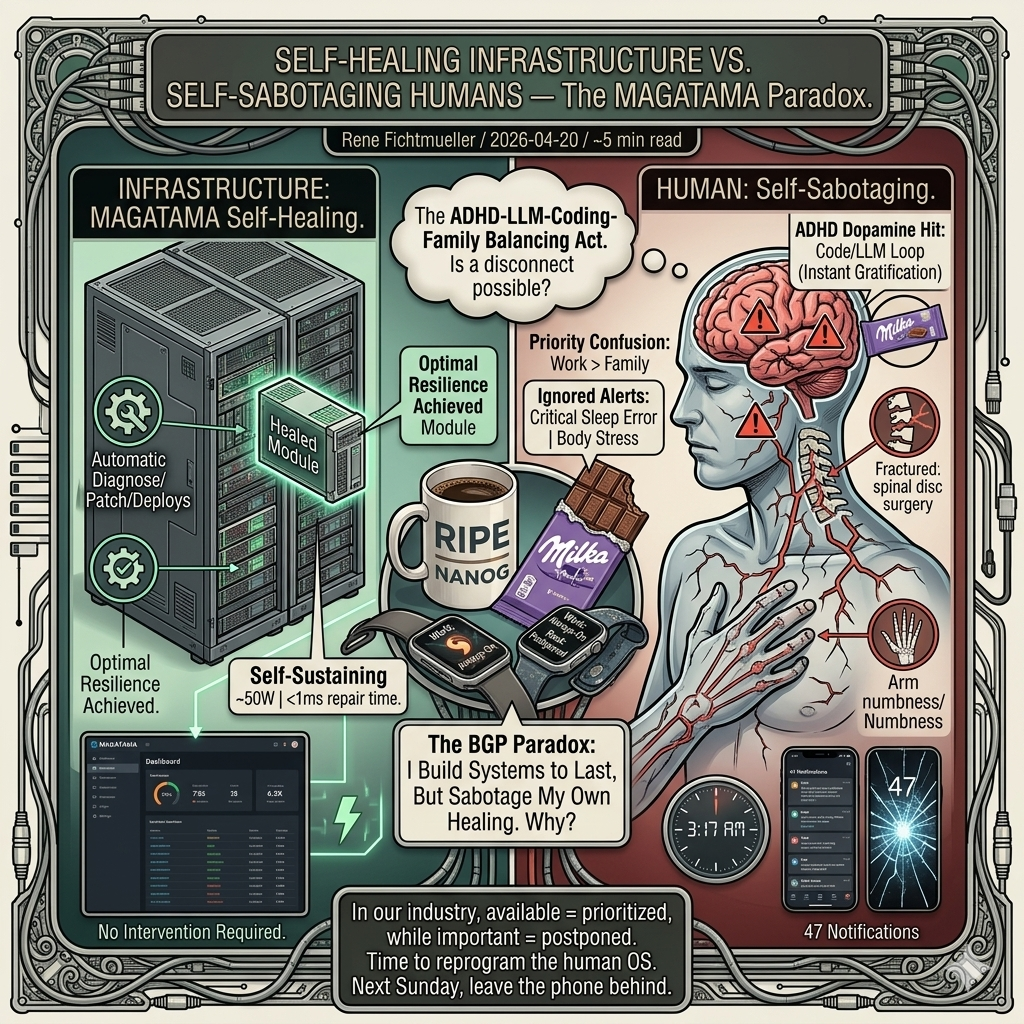
It's 3:17 AM. I'm sitting in front of my MAGATAMA dashboard watching something fascinating. My system finds an error, diagnoses it, writes a patch, tests it, and deploys it. All automatically. No intervention required. The system heals itself.
Meanwhile, I'm eating my third Milka chocolate bar since midnight, I have a headache, and I'm ignoring five messages from Claudi asking when I'm finally going to bed. My phone is next to me. Slack is open. Email in the background. Instagram, where I shouldn't be. My system is self-healing. I am self-sabotaging.
This is the paradox that just won't let me go: I'm building infrastructure that's smarter than I am. Systems that recognize and fix their own errors before I even know something went wrong. MAGATAMA learns from attacks, recognizes patterns I've missed. The system gets better while I get worse.
My code is resilient. I am fragile. My code has redundancy. I don't. And the crazy part is: I know this. I know how to build robust systems, but I can't apply it to myself.
MAGATAMA has self-healing modules. It recognizes when something's wrong and fixes it proactively. I recognize when something's wrong — my health, my marriage, my sleep — and I ignore it. The system says "critical error, action required." I say "later, after the project." The system escalates, alerts, acts. I procrastinate, rationalize, self-sabotage.
And now it's even harder. Back in November, I had disc surgery on my spine. Since then, I've been running from one doctor to another. My index finger and thumb are numb. I'm progressively losing strength in my left arm. My neck hurts. One neurosurgeon says there's inflammation in the area of the operated vertebra. The other says everything is fine. And while I'm processing all this, sitting here at 3:17 AM at the laptop, I'm choosing not to heal. That isn't just self-sabotage. That's active self-destruction.
I build systems for others that don't collapse. Meanwhile, I'm here, eating chocolate at 3:17 AM, my phone glowing next to me, my left arm numb, waiting for myself to break down instead of doing something proactive about it. That's self-sabotage. That's the conscious choice not to heal.
In our industry, this is standard. Permanently reachable. Permanently online. The phone isn't just a tool, it's a shackle we put on ourselves. Slack is a control mechanism we've accepted. Email is proof that we matter. And if we don't respond, then we don't matter. So we always respond. At 3:17 AM. At 11:45 PM. On vacation. In bed. During dinner with family.
And then, one Sunday, I tried it. I simply didn't bring my phone. Just in the morning, a few hours. No Slack. No email. Nothing. Just silence. And it was pleasant. It was quiet. It was normal. My brain calmed down. My shoulders relaxed. I played with Phibie. Really played. Not the "I'm playing with you but my phone is next to me" kind of playing, but real playing. And I realized how much I'd missed it.
But when I turned the phone back on, there were 47 messages. Nothing critical. But they were there. And immediately I was back in work mode. Work thinking. Always-on. The moment was gone.
This is the deepest paradox in our industry: We say "family is priority number one." We write it in our Slack bio. We say it in meetings. We even believe it ourselves. But our actions speak a different language. The phone is priority one. The deal is priority one. Work is priority one. Family is, no matter how much we deny it, secondary. It's what we do when work is over. And work is never over.
So we reprogram ourselves. We say "family is important" and our neurology hears "work is important, family is the buffer between." We train ourselves into priority confusion. Every day, every Slack ping, every 10 PM email reinforces the message: your work is more important than your rest. Your availability is more important than your family.
And here's where it gets even worse. Coding with ADHD is a drug. I mean that literally. The hyperfocus phase while writing code is a dopamine hit of the highest order. Writing a line of code that works — that's instant gratification. Building a feature — that's a measurable result. Solving a problem — that's a direct win. And now, with LLMs, with systems that understand and generate code, the speed is exponential. I tell the AI what I need, and it delivers the code. I can build systems that would have taken days in hours. The dopamine kick is stronger. The addiction is worse.
And that makes the balancing act even bigger. Not just travel, not just events, not just KPIs. Now also this: I can write an automation that saves my team 20 hours a week. I can write a script that simplifies a friend's life. I can debug a system and have it working again in two hours. That's fascinating. That's incredible. It gives me purpose, an identity: The one who fixes it. The one who builds systems. The one who solves problems. And every time I do that, my family gets neglected an hour more. Every script I write for a colleague is an hour less with Phibie. Every automation I build is another night I'm in front of my dashboard instead of next to Claudi in bed.
LLM-assisted programming changed the game. It's no longer "I have to work so I have money." It's "I can do anything, and it will work, and it will be fast, so why not one more, one more, one more." My ADHD brain is in the perfect dopamine loop. Write code, use AI, see results immediately. Rinse and repeat. The industry just handed me a tool that turned my own self-sabotage machine into turbo mode.
The ADHD-coding-LLM combination is like a newly developed drug with no antidote. Because the antidote would be: slow down. Set boundaries. Say no. And that's physically impossible for an ADHD brain in hyperfocus. It's like handing an alcoholic a beer and saying: it's okay, just drink it in moderation.
The family notices. They notice that the industry just gave me a new tool to ignore them. That now, with LLMs, I can be even more productive, deliver even more, be even more available. The balancing act doesn't get bigger because I work more. It gets bigger because I work faster. Because I can accomplish even more, even quicker. And that means: even less time for what matters.
And the irony is: these tools are built to simplify life. To boost productivity. To help people. And they do. But they also help me lose my family. They also help me sabotage myself. They're designed to make me more productive, not happier.
And now, as I write this, MAGATAMA is running in the background, my code editor is open, and I realize I'm spending another hour on something that isn't my family. And the crazy part is: it feels right. It feels important. It feels necessary.
I know how to build systems that don't fail. But I don't know how to do that with myself. Or worse, I know but I don't want to. Or even worse, I know it's wrong but the industry taught me it's right. And now the industry has also given me the perfect drug to do it better.
Next Sunday will come. I'll leave the phone behind again. Maybe. If I dare.
How do you see it?