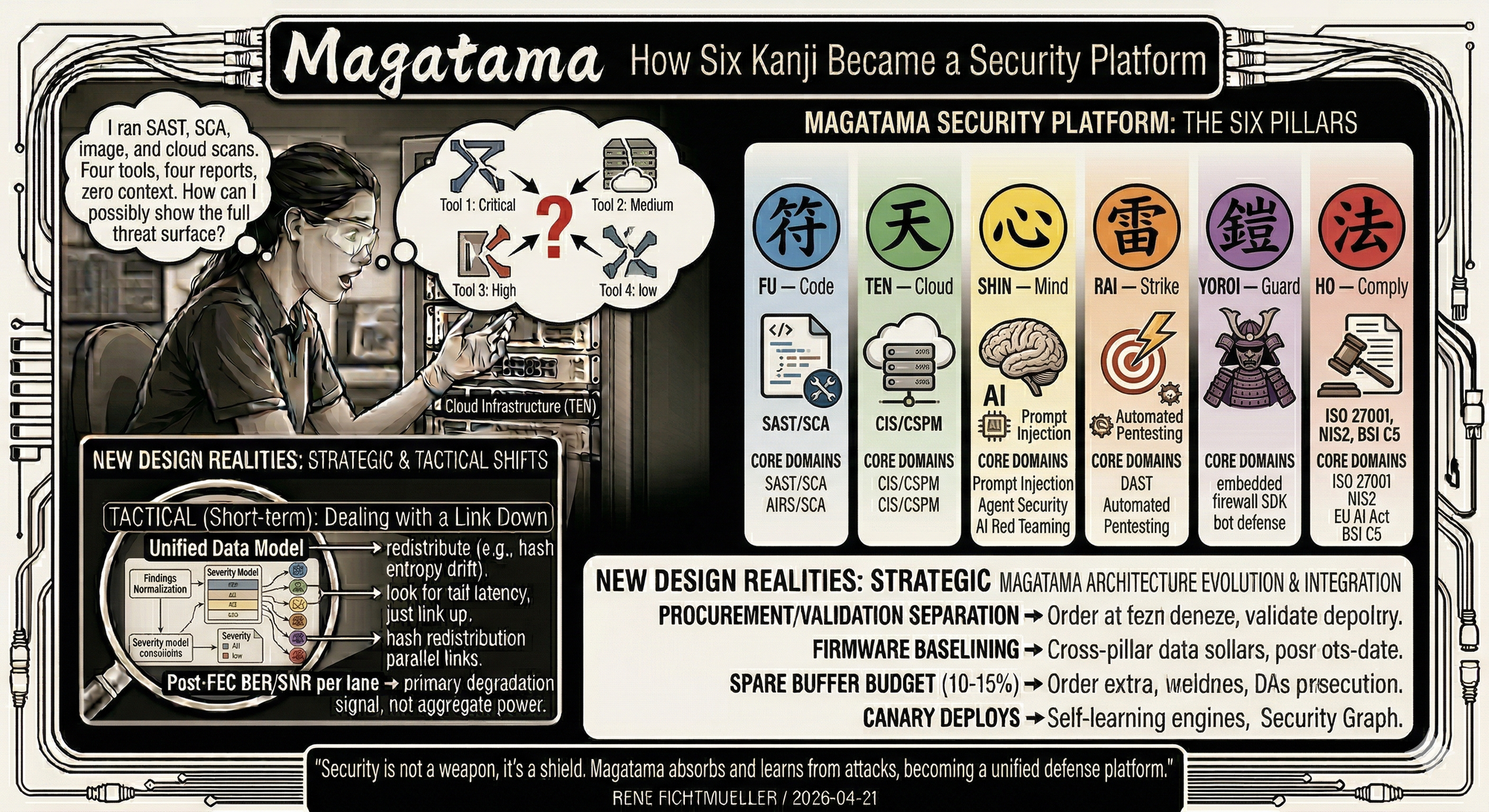
MAGATAMA 勾玉: Building a Security System That Learns From Every Fix
MAGATAMA is evolving from a security dashboard into a system that detects, prioritizes, remediates, verifies and learns from real incidents.
MAGATAMA 勾玉: Building a Security System That Learns From Every Fix
Most security tools are excellent at producing visibility and strangely weak at producing relief.
They detect, label, classify, score, and sort. They draw polished dashboards and generate reports that are often accurate, sometimes elegant, and almost always incomplete. The reason is simple: the real work begins after a finding appears. Someone still has to understand what matters, connect related signals, decide what to fix first, apply changes without causing damage, verify the result, and make sure the same class of problem can be handled faster next time.
That gap is why MAGATAMA exists.
I did not start with the idea of building another security dashboard. I started with the much less glamorous feeling that I had too many tools telling me what was wrong and too few systems capable of carrying the work forward. One scanner would flag a code issue. A cloud check would surface something adjacent. Runtime telemetry would hint at a pattern that neither of the first two could see. The problem was never a total lack of data. The problem was the handoff. Security stacks are usually good at detection and remarkably fragile at execution.
MAGATAMA began as an attempt to close that gap. Not with more decoration, but with a tighter loop. Detection should flow into prioritization. Prioritization should flow into resolver assignment. Resolver work should produce artifacts, verification, rollback awareness, and memory. And memory should not just live in a PDF or a chat log. It should become part of the system itself.
That is also why the name felt right from the beginning. Magatama, 勾玉, carries associations of protection, continuity, and inherited value. I liked that immediately. This was never meant to be an offensive toy or an “AI copilot” that produces summaries and disappears. I wanted something more durable: a defensive system that becomes more useful as it sees more environments, more incidents, and more verified remediations.
Today, MAGATAMA is no longer just an idea with a nice name. It has grown into a real security operating layer. It correlates findings across code, cloud, infrastructure, telemetry, host integrity, and AI-related risk. It routes remediation work to resolvers such as MagatamaLLM, Claude, and Codex. It keeps a fix history, writes artifacts, tracks rollback candidates, and decides what enters the learning chain. In practice, that means the platform does not just show problems. It begins to absorb them.
What makes this interesting to me is not the dashboard surface, although that matters too. What matters is the compounding effect underneath it. Every real issue that is handled cleanly improves the next decision. Every verified artifact becomes reusable memory. Every exposure that is mapped, tracked, assigned, remediated, and verified makes the platform harder to fool and faster to act. A traditional security stack generates pressure. A useful security system absorbs pressure.
That shift is already visible in the live system. As of today, MAGATAMA is operating with 35 open findings, 1,035 verified fix artifacts, 46 known assets in the Atlas, 40 assets with live telemetry, and 71 monitored services. The remediation footprint is already real: 928 verified remediations are attributed to MagatamaLLM, 94 to Claude, and 13 to Codex. At the same time, 1,007 artifacts have already been appended into the training chain, and the platform has processed 7,883 learning or fix attempts. Those are not the kind of numbers you put on a landing page because they sound good. They are the operational trail of a system that is already doing real work.
What I like most about that is not the scale. It is the shape. MAGATAMA is beginning to behave less like a passive interface and more like institutional memory with execution attached. It can see an exposure, connect it to a host, route it to a resolver, track the remediation path, record what changed, and feed that back into its own learning loop. That is the moment when security tooling starts to stop feeling like software in the ordinary sense. It starts to feel like a system developing reflexes.
There is still a lot left to do. The infrastructure map needs to become deeper and even more honest. Enforcement needs to become stronger without becoming reckless. Resolver state needs to be reliable across every path, not just the happy ones. Training control needs to become more deliberate, so the platform not only learns quickly but learns well. In other words, MAGATAMA is already real, but it is not finished. That is fine. The interesting phase is rarely the polished end state. The interesting phase is when a system starts proving that it can survive contact with reality and improve because of it.
That is where MAGATAMA is now.
There are already enough security products that produce output. What I care about is building a system that produces outcomes. Something that does not stop at detection, but learns how to carry the burden of remediation, verification, and memory with more precision every time it is tested.
That is the real ambition behind MAGATAMA 勾玉.
Not another dashboard.
A system that gets stronger every time the environment tries to break it.