Third-Party Optics: The Real Risk vs the Vendor Story
Cisco says third-party optics void your support contract. The MSA says otherwise. Here's what the standards actually guarantee, what vendor lock costs at scale, and how to run the risk-adjusted calculation.
The conversation follows the same script every time. Network engineer asks about third-party SFP+ modules. Cisco account team sends a document about support implications. Engineer backs down. The network runs on $800 Cisco-branded SFP+ modules that cost $180 from six other manufacturers using the same Finisar laser.
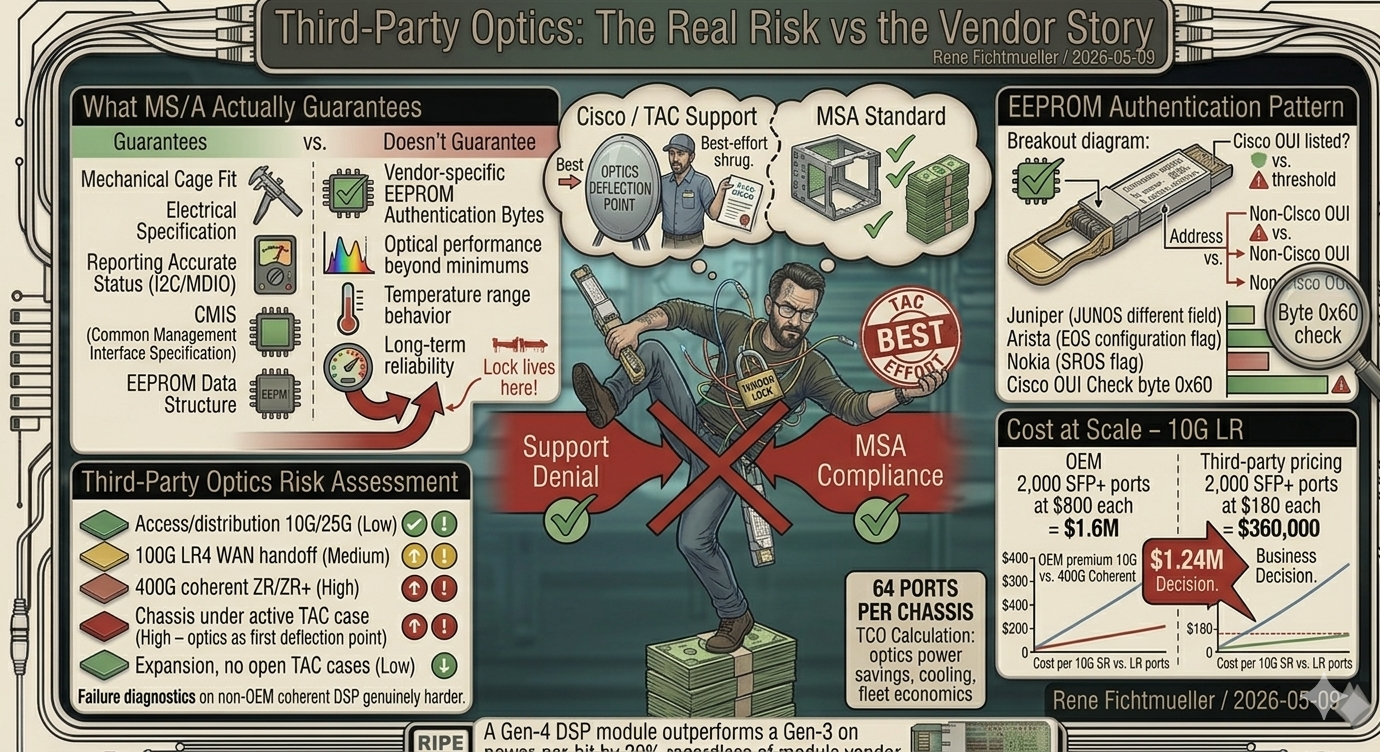
Multi-Source Agreement standards (SFF-8472, SFF-8636, CMIS) define the physical interface, electrical characteristics, and EEPROM data structure for optical transceivers. MSA compliance ensures any compliant module fits the mechanical cage, draws within electrical spec, and reports accurate status via I2C/MDIO.
MSA does not guarantee: optical performance beyond minimums, temperature range behavior, long-term reliability, or compatibility with vendor-specific EEPROM authentication bytes. That last point is where the lock lives.
Cisco IOS checks byte 0x60 of the SFP EEPROM — the vendor OUI — against an internal approved list. Non-Cisco OUI: the interface comes up with a service unsupported warning and potentially reduced monitoring thresholds. The physical link still works. TAC support on that interface becomes "best effort."
Juniper JUNOS does the same with a different field. Arista EOS allows third-party optics with explicit configuration and logs a warning. Nokia SROS requires a chassis configuration flag. The implementation varies; the underlying pattern is identical across vendors.
The risk isn't technical failure. MSA-compliant modules from Lumentum, Coherent, or InnoLight have failure rates comparable to OEM equivalents using the same underlying components. The risk is support friction when something else fails and the vendor uses optics as the first deflection.
2,000 SFP+ 10G LR ports at OEM pricing ($800 each): $1.6M. Third-party MSA-compliant alternative ($180 each): $360,000. Delta: $1.24M. At that scale, most operators either negotiate explicit third-party optics coverage in the support contract, or accept the support friction as a $1.24M business decision.
At 400G coherent, the math shifts. ZR+ modules have fewer third-party options, smaller volume production, and more complex failure modes. The support risk is real because failure diagnostics on non-OEM coherent DSP silicon are genuinely harder. OEM premium at 400G coherent is harder to arbitrage than at 10G.
OEM for: active TAC contracts where escalation risk is high, 400G coherent until the third-party market matures, any optics type with fewer than three qualifying suppliers.
Third-party for: all short-reach interconnect (SR4, SR8, intra-DC), 10G/25G LR on access/distribution, 100G LR4 on internal WAN from established suppliers (Lumentum, Coherent, InnoLight, Eoptolink). Document supplier qualification. Keep spares. The savings justify the process.
Run the risk-adjusted cost calculation with both scenarios before choosing either policy. The vendor framing is "risk of third-party." The honest framing is "risk-adjusted cost of vendor lock at scale."