DSP Power: The Budget Item That Keeps Growing
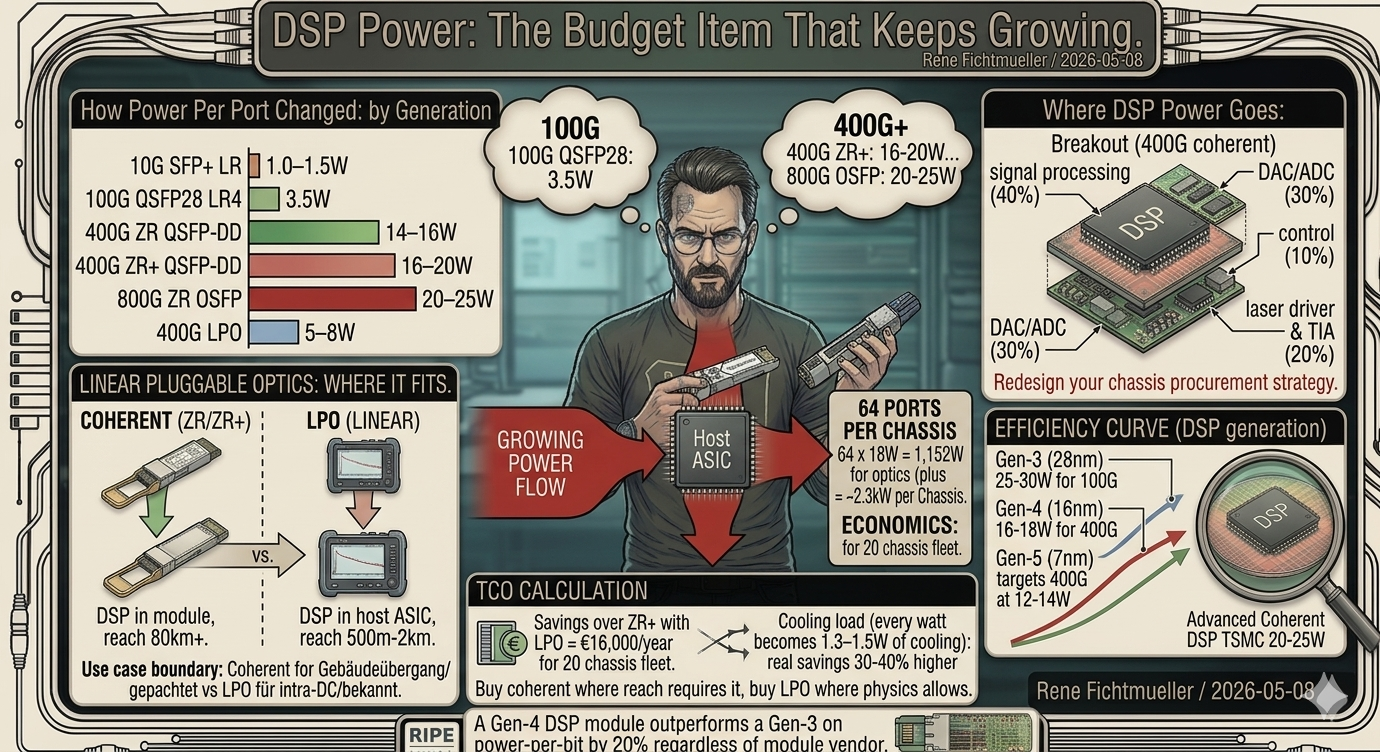
A 400G coherent port draws 16–20W. At 64 ports per chassis: 1.3kW just for optics. DSP power is a real constraint in dense deployments — and most capacity plans ignore it.
The 400G coherent module in your QSFP-DD slot draws 16–20 watts. The router slot powering that module had a 3.5W TDP in the original chassis spec from 2019. The resulting math explains why several large operators paused 400G coherent deployments in 2024 and redesigned their chassis procurement strategy.
The 100G-to-400G jump brought a 5× increase in power per port. Chassis designed for 3.5W QSFP28 slots can't run full-power ZR+ without airflow and power supply upgrades. Operators who bought Cisco NCS 5500 or Juniper PTX series in 2020 for 100G core now face a hardware refresh just to run 400G coherent at full density.
A coherent DSP at 400G breaks down roughly: 40% signal processing (FEC, equalization), 30% DAC/ADC, 20% laser driver and TIA, 10% control and management. The DSP ASIC is the dominant consumer and hardest to reduce without moving to a smaller process node.
Gen-3 DSPs (28nm) ran 25–30W for 100G coherent. Gen-4 (16nm) dropped to 16–18W for 400G while quadrupling throughput — a 7× efficiency improvement. Gen-5 (7nm) targets 400G at 12–14W. The efficiency curve improves, but each generation takes 3–4 years to reach volume production.
LPO removes the DSP from the module entirely, shifting signal processing into the host ASIC. Power drops to 5–8W. Cost drops 40–60%. Reach drops to 500m–2km. Right tradeoff for intra-datacenter: spine-to-leaf, storage interconnect, server uplinks.
LPO at 400G uses 3×PAM4 lanes, no retimer, no DSP in the module. The host ASIC (Broadcom Tomahawk 5, Marvell Teralynx 10) handles equalization. The host-side DSP cost is shared across 64+ ports instead of paid once per pluggable.
The use case boundary: LPO for reaches under 2km on known, clean fiber inside a datacenter. Coherent ZR/ZR+ for anything crossing a building boundary, using leased fiber, or requiring FEC margins for aging infrastructure.
A 64-port 400G coherent chassis running ZR+: 64 × 18W = 1,152W for optics, plus ~1,150W for ASIC, fabric, management. Total: ~2.3kW. At €0.12/kWh: €2,400/year per chassis. A fleet of 20 chassis: €48,000/year just in optics power.
Same chassis with LPO: 64 × 6W = 384W. Savings over ZR+: 768W per chassis. At 20 chassis: 15.36kW saved = €16,000/year. Add cooling load (every watt of power becomes 1.3–1.5W of cooling): the real savings number is 30–40% higher.
Buy coherent where reach and margin require it. Buy LPO where physics allows. Know the boundary before signing the BOM.