ADHD, No-Travel-Days, and the Absence of Structure
I travel 180 days a year. Airports, hotels, conference venues, customer meetings. Every day has a fixed schedule. Flight at 08:15. Meeting at 10:00. Dinner with customers at 19:30. Alarm at 06:00. The structure is external. I don't build it. The calendar does.
Then I have a no-travel day. No meetings. No flights. No external structure. And my brain eats itself alive.
ADHD at 40 does not look like the hyperactive kid bouncing off walls. It looks like sitting at a desk with 47 browser tabs open, three half-written emails, a terminal with six SSH sessions, and a task list that grew by 12 items since morning because every task spawned two more.
It looks like starting to fix a bug in ShieldX, noticing a log message that reminds you of a PeerCortex issue, switching to PeerCortex, seeing a dependency update, checking the dependency's changelog, reading a blog post linked from the changelog, having an idea for your own blog, opening a draft, writing three paragraphs, remembering the ShieldX bug, and realizing two hours have passed.
That is not a productivity problem. That is how the brain works. The dopamine regulation system fires differently. Novel tasks generate reward. Routine tasks don't. The brain chases novelty because it needs the chemical kick that neurotypical brains get from finishing a checklist.
Travel provides the external structure that ADHD brains struggle to build internally. Every transition point is a forcing function. You can't keep browsing because the boarding gate closes. You can't context-switch because the customer is sitting across the table. You can't spiral because the hotel alarm goes off in six hours and the presentation is at 09:00.
I am more productive at airports than at my home desk. That sentence sounds absurd until you understand the ADHD dopamine model. The airport provides novelty (new environment), urgency (flight departure), and constraint (limited time). My home desk provides none of those.
Context switches Travel: forced by events | Home: uncontrolled
Dopamine triggers Travel: novelty + urgency | Home: self-generated only
Productive hours Travel: 8–10h | Home: 3–4h focused (14h at desk)
Hyperfocus risk Travel: low (interrupts break it) | Home: high (8h tunnel)
Guilt cycle Travel: none | Home: constant ("why can't I focus?")
ADHD has two modes: scattered and tunnel. Scattered is the browser tabs and context switches. Tunnel is hyperfocus. You lock onto a task and the world disappears for eight hours. You forget to eat. You skip meetings. You produce an astonishing amount of output on one thing while everything else rots.
155 commits in 8 days. 74 new features. 62 bug fixes. I published those numbers in ADHD Diary #002 like they were achievements. They were symptoms. My brain found a dopamine vein and mined it until exhaustion.
The output was real. The cost was invisible. Missed meals. Skipped exercise. Emails unanswered for days. Relationships on hold. The crash after hyperfocus feels like hangover without the party.
I have tried every productivity system. GTD, Pomodoro, time blocking, bullet journaling, apps with gamification. They work for a week. Then the novelty fades and the ADHD brain discards them like a toy it already played with.
What survived:
Public accountability Telling someone "I'll ship X today" creates external pressure
Physical movement Walk before sitting down. Reset the nervous system.
Task size limit Nothing longer than 45 minutes. Break it or lose it.
First task ritual Start with something small and completable. Build momentum.
LLM as co-pilot Claude as body double: maintains context when my brain loses it
Accept the wiring Stop fighting the brain. Design around it.
The LLM-as-body-double discovery changed my workflow. Claude Code maintains project context across sessions. When I context-switch (and I will), the conversation history holds the state my brain dropped. I come back, read the last three messages, and re-enter the task without the 20-minute ramp-up that used to cost me half my productive time.
I'm not saying AI fixes ADHD. I'm saying a tool that remembers what you were doing, where you left off, and what comes next compensates for the exact cognitive function that ADHD impairs: working memory.
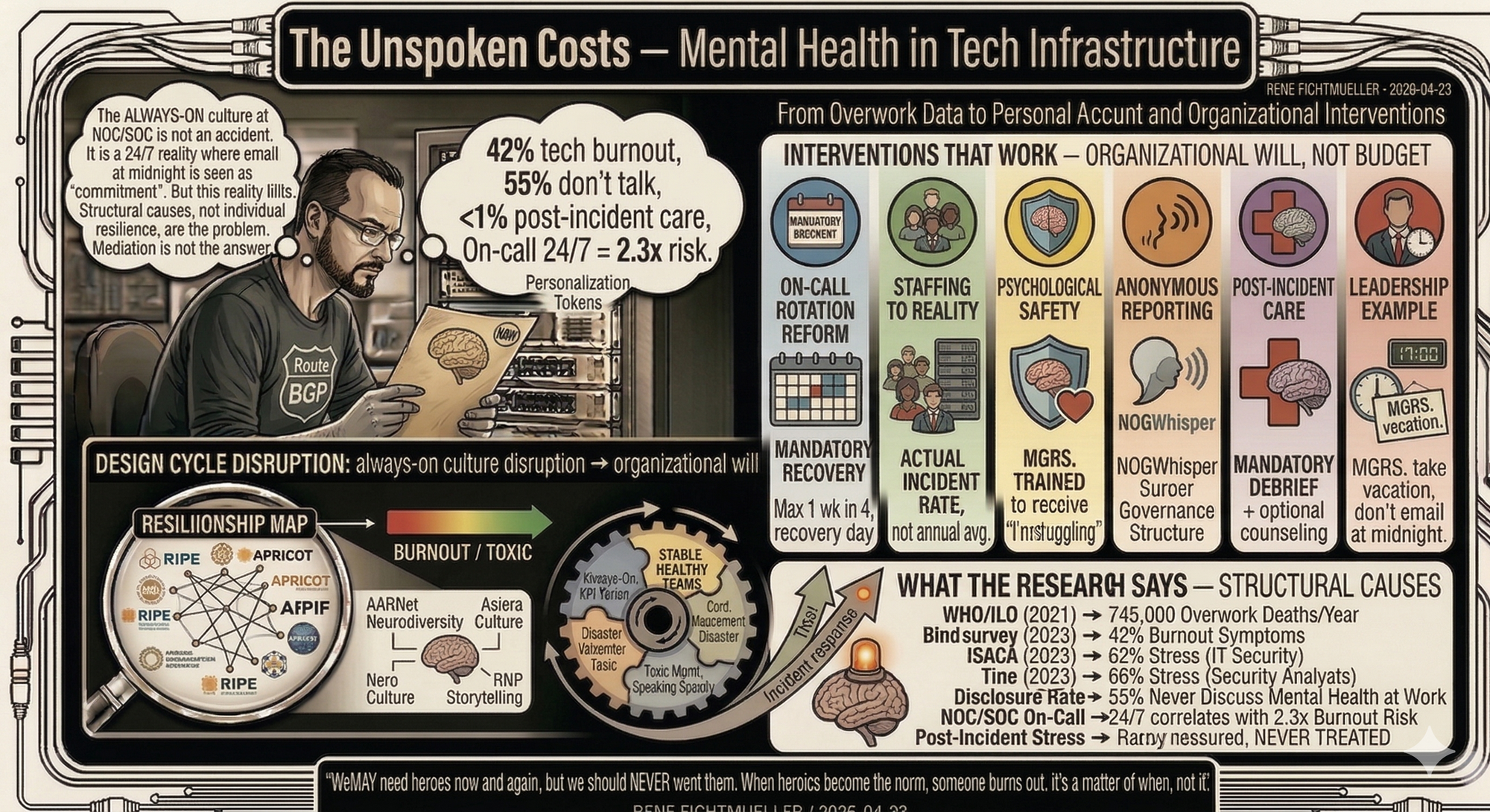
55% of tech workers with mental health challenges don't talk about it at work. I understand why. Disclosure feels like handing someone ammunition. "Rene can't focus, give the project to someone reliable."
I write about it because silence is what made it worse. The years I spent masking ADHD in professional settings burned more energy than the actual work. Pretending to follow a two-hour meeting when your brain checked out at minute fifteen. Pretending the deadline pressure doesn't feel like drowning. Pretending you chose to work until 2 AM when your hyperfocus held you hostage.
If you're in infrastructure and your brain works like mine, you're not broken. You're wired for a different kind of work: rapid context switching in a NOC, pattern matching across network telemetry, creative problem-solving during an outage. The same wiring that makes desk days painful makes crisis response natural.
Design your life around the wiring. Stop trying to fix it.