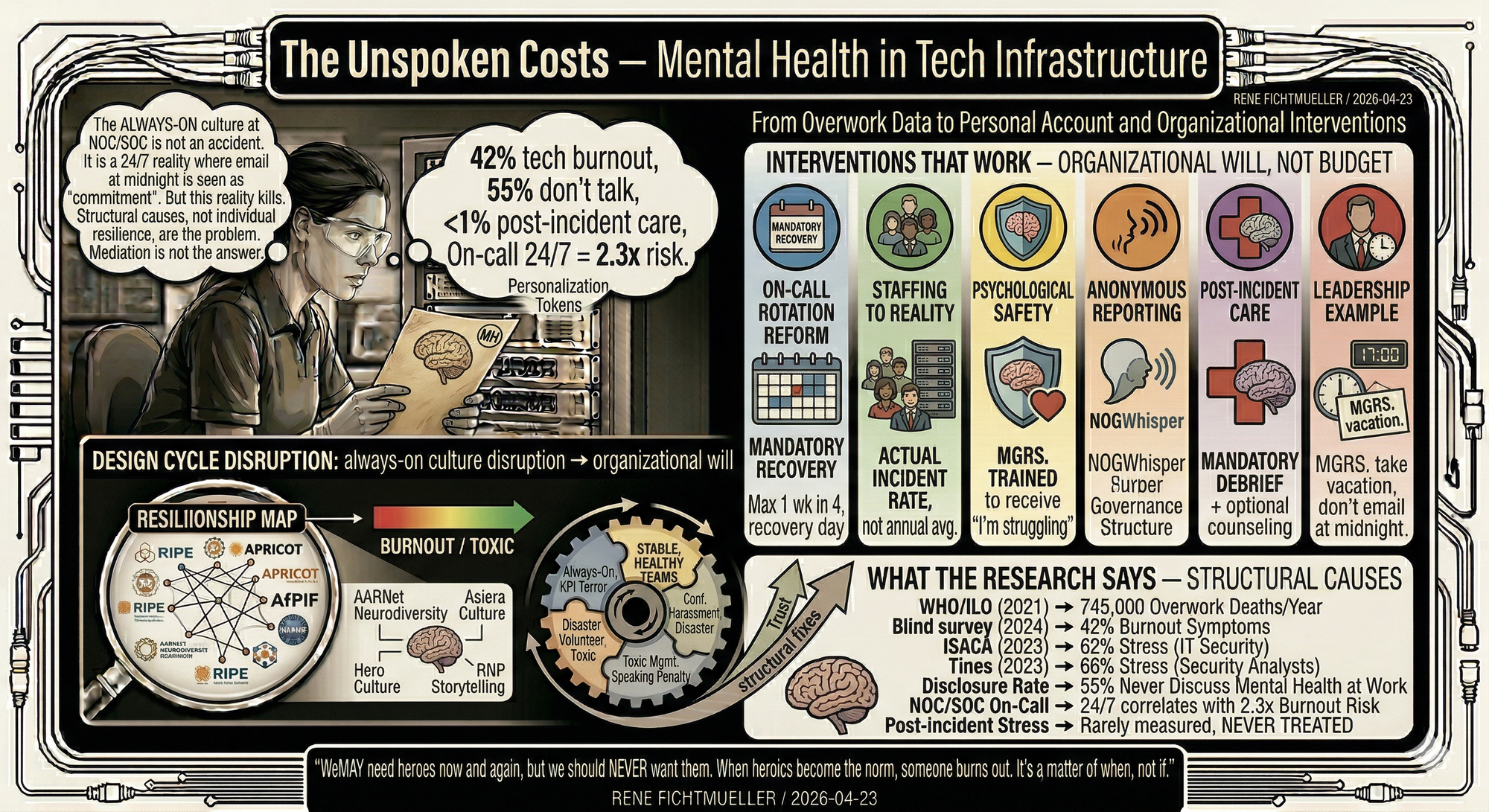
The Unspoken Costs — Mental Health in Tech Infrastructure
745,000 people die from overwork every year. That number comes from the WHO and the ILO jointly, published in 2021, covering data through 2016. The actual number in 2026 is higher. Nobody has updated the study.
42 to 62 percent of IT infrastructure workers report burnout symptoms. 55 percent don't talk about it. I know these numbers because I spent months collecting them after I survived a suicide attempt.
I worked in a toxic environment for years. The kind where 60-hour weeks are baseline. Where answering emails at midnight is "commitment." Where your manager tells you the workload is normal and the problem is your attitude. Where raising concerns about staffing gets you labeled as "not a team player."
I internalized it. If everyone else handles the pressure, the failure must be mine. I pushed harder. I traveled more. I took on more projects. I stopped sleeping properly. I stopped seeing friends. I stopped doing anything that wasn't work.
The breaking point came without warning. One day the math in my head changed. The pain of continuing outweighed everything else. I acted on it. I survived because of luck, not because the system caught the signs.
The system had no mechanism to catch the signs. No check-in process. No psychological safety. No way to say "I'm drowning" without risking your career.
After recovery, I turned the experience into research. 60+ sources. Academic papers, WHO reports, industry surveys, case studies from tech companies that lost people. The structural causes are documented. Nobody reads the documentation.
Blind survey (2024) 42% of tech workers report burnout symptoms
ISACA (2023) 62% of IT security pros report work-related stress
Tines (2023) 66% of security analysts experience significant stress
Disclosure rate 55% never discuss mental health at work
NOC/SOC on-call 24/7 rotation correlates with 2.3x burnout risk
Incident response Post-incident stress rarely measured, never treated
The always-on culture in infrastructure is not an accident. It grew from the reality that networks run 24/7 and someone needs to respond when they break. That reality became a culture where being available at 3 AM is a badge of honor. The badge kills people.
Individual resilience is not the problem. "Learn to meditate" is not the answer. The causes are structural. Organizations build systems that burn people out, then offer wellness apps as treatment.
KPI terror Metrics that measure activity, not outcomes
Understaffing Teams sized for steady state, not reality
Hero culture "Going above and beyond" as baseline expectation
Conference harassment Documented at tech events, rarely addressed
Disaster volunteer burnout Volunteers who reconnect infrastructure after disasters, then get forgotten
Toxic management Criticism as management tool, no psychological safety
Career penalty for speaking up "Not a team player" label for raising concerns
Brian Nisbet from Asiera frames it well: we should aim for the ordinary so that services operate and people can live their lives. We may need heroes now and again, but we should never want them. When heroics become the norm, someone burns out. It's a matter of when, not if.
The solutions exist. They are not new. They require organizational will, not budget.
Staffing to reality Size teams for actual incident rate, not annual average
Psychological safety training Managers trained to receive "I'm struggling" without penalty
Anonymous reporting Whistleblowing systems with governance (see: NOGwhisper)
Post-incident care Mandatory debrief + optional counseling after major incidents
Conference codes of conduct Enforced, with visible reporting channels
Workload audits Quarterly review of actual hours vs contracted hours
Leadership example Managers who leave on time, take vacation, don't email at midnight
I'll be presenting this research at TNC 2026 in Helsinki. The session is called "The Art of Being Human." Teresa Grove from AARNet will talk about neurodiversity and psychosocial safety. Brian Nisbet will talk about hero culture. Leonie Gomes Gouveia from RNP will talk about storytelling as a tool for institutional purpose.
My talk covers the data, the personal story, and the structural fixes. 745,000 people die from overwork every year. The solutions exist. What's missing is the will to act.
If you're struggling, talk to someone. Not because it's easy. Because silence is what got me to the point where I nearly didn't survive. The infrastructure community is small enough that we can look out for each other. We build resilient networks. We should build resilient teams.
If your organization needs a starting point, look at FOGhorn: FOGhorn. Anonymous reporting with governance structure. Because the first step is making it safe to speak up.