Pluggable Coherent in 2026: What's Shipping, What's Vaporware
800G ZR modules are announced. 1.6T is on the roadmap. Meanwhile, half the 400G ZR+ SKUs take 14 weeks to ship. Here's what's real in pluggable coherent today.
Every coherent optics vendor had an 800G announcement at OFC 2025. Half had working silicon. A third had modules you could hold. Two shipped in volume before Q4. The pluggable coherent market runs 18 months behind the press release cycle. That gap matters when you're planning a network refresh.
The form factor war is settled: OSFP wins for 800G and above. QSFP-DD maxes out at 800G with thermal constraints that require active cooling in most line card slots. OSFP has the power budget headroom for 800G coherent DSPs at 20–25W. QSFP-DD800 exists as a standard but most operators are skipping it.
Both target the same form factors. Both run on 400G coherent silicon. The difference is in the framing layer and what the network sees upstream.
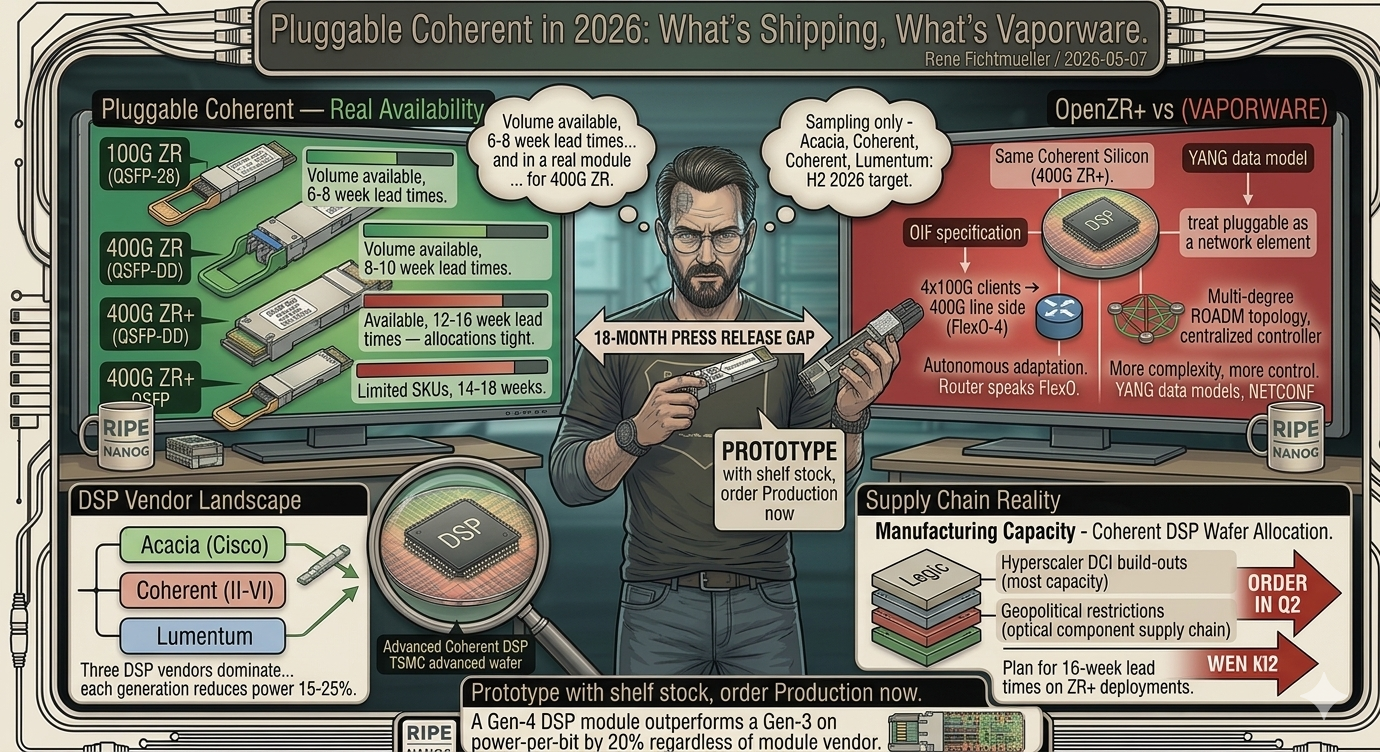
OpenZR+ (OIF specification) packages 4×100G clients into a single 400G line side using FlexO-4. No vendor-proprietary management plane required. Works with any router that speaks FlexO. The module manages modulation adaptation autonomously.
OpenROADM (AT&T-initiated, 40+ member companies) adds a full YANG data model, NETCONF management interface, and media channel configuration. It treats the pluggable as a network element. More operational complexity, more control. Required for multi-degree ROADM topologies with automated spectrum management.
For point-to-point DCI: OpenZR+. For multi-degree mesh WAN with centralized controller: OpenROADM. Buying the wrong one doesn't make the link fail — it makes management impossible at scale.
Three DSP vendors dominate: Acacia (now Cisco), Coherent (formerly II-VI/Finisar), and Lumentum. Each generation reduces power by 15–25% while increasing FEC gain. A Gen-4 DSP module outperforms a Gen-3 on power-per-bit by 20% regardless of which module vendor you buy from. When you buy from smaller module vendors, you're often buying the same DSP silicon with different packaging and firmware.
400G ZR+ allocation tightened in Q3 2025 and hasn't recovered. Hyperscaler DCI build-outs consumed most manufacturing capacity for coherent DSP wafers from TSMC advanced nodes, and geopolitical restrictions on certain optical component supply chains pushed lead times up further.
Plan for 16-week lead times on ZR+ deployments. If you're building a network refresh for Q4 2026, order in Q2. Prototype with what's on the shelf; production order goes in before architecture is finalized. Not ideal engineering practice — current market reality.
The real transition to watch: 400G ZR becoming a commodity. When ZR+ prices drop below $2,500, the ZR vs ZR+ decision collapses and you buy ZR+ everywhere. That inflection point is 12–18 months out.