Social Selling in Infrastructure — Not the LinkedIn Version
A vendor sent me a LinkedIn message last week. "Hi Rene, I noticed you're in the optical networking space. We have a solution that could transform your operations. Would you be open to a 15-minute call?"
I sell optical transceivers for a living. I know what social selling looks like from the inside. That message is not it.
Social selling is not mass outreach with personalization tokens. It is not "I noticed you liked a post about DWDM, here's our DWDM product sheet." It is not a connection request followed by an immediate pitch. It is not an InMail drip sequence with three follow-ups and a "just bumping this to the top of your inbox."
Every LinkedIn guru selling a social selling course teaches these tactics. Every buyer in infrastructure has learned to ignore them. The open rate on cold InMails in B2B networking equipment sits between 5% and 12%. The response rate is under 2%. You're paying $30 per InMail to be ignored by 98 out of 100 people.
Response rate 1.5–2.5%
Cost per InMail $25–$30
Cost per response $1,000–$2,000
Deals closed from cold InMail Near zero in complex B2B
I have closed deals worth six figures with people who contacted me first. Not because I sent a pitch. Because they had read something I wrote, attended a talk I gave, or saw me answer a technical question in a forum. When they needed transceivers, my name was already in their head.
Social selling in infrastructure means building credibility before you need it. You share what you know. You answer questions in public. You write about problems your customers face. You show up at events and talk about technology, not products. When someone has a procurement need six months later, they remember the person who helped them debug an optics issue at RIPE, not the person who sent them an InMail.
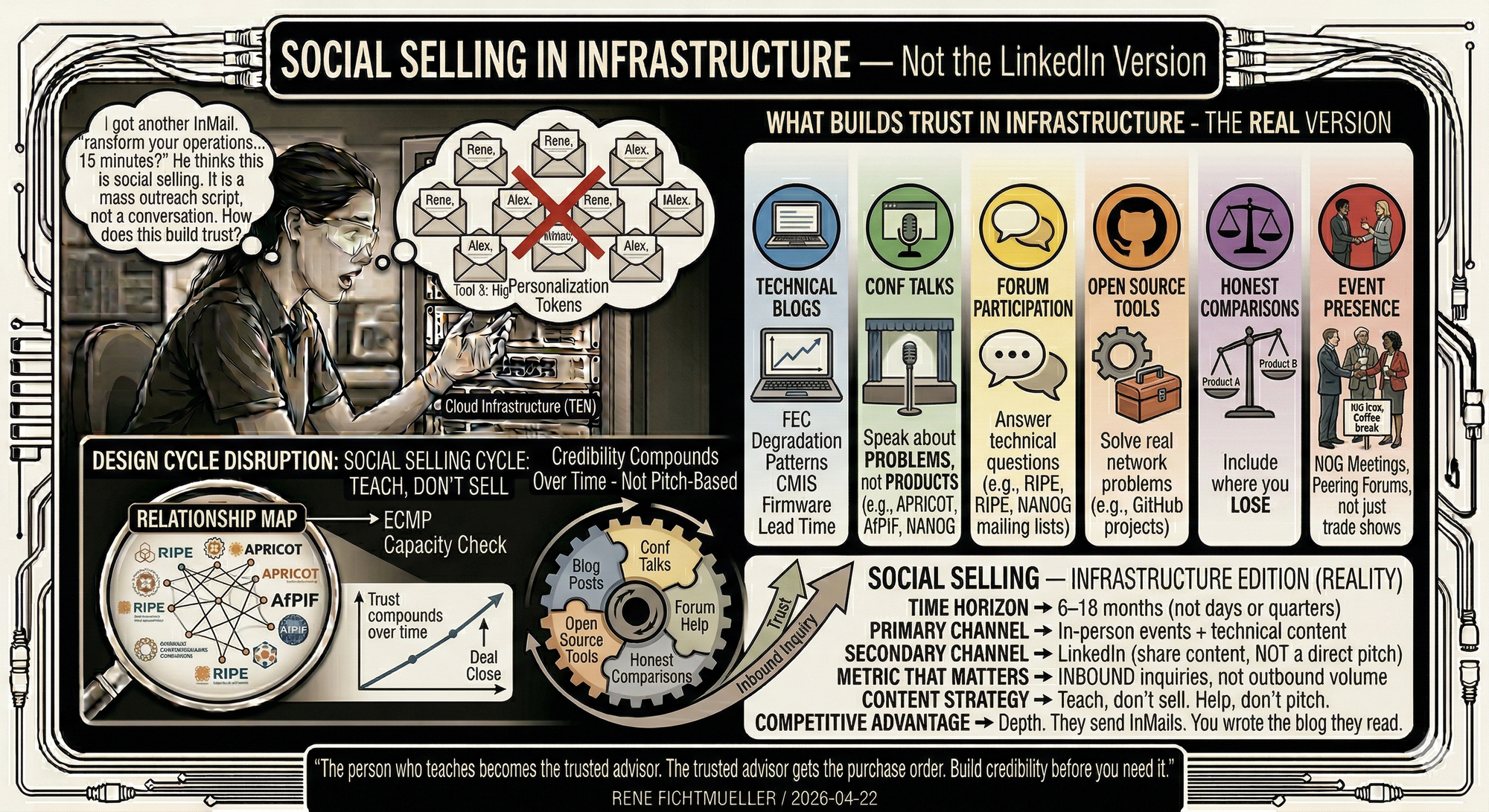
Conference talks Speak about problems, not products
Forum participation Answer questions on NANOG, RIPE, vendor forums
Open source contributions Build tools that solve real problems
Honest product comparisons Compare your product fairly — including where you lose
Event presence Be at NOG meetings, peering forums, not just trade shows
The infrastructure community is small. Optical networking is smaller. The people who buy 400G optics attend the same 10 events, read the same 5 mailing lists, and talk to each other. A single bad experience with a salesperson travels faster than any LinkedIn post.
I write blog posts about optical networking because I find the technology interesting. Some of those posts rank on Google. People read them, find them useful, and look at who wrote them. They see FLEXOPTIX. When they need optics, they think of FLEXOPTIX.
The blog is not a marketing campaign. I don't write about our products. I write about firmware bugs, FEC behavior, CMIS state machines, and lead time problems. Technical content that helps engineers solve real problems. The sales happen because trust compounds over time.
A post about 400G degradation patterns does more for pipeline than ten InMails. It reaches people I could never target because I don't know they exist yet. It stays indexed for years. It gets shared in Slack channels I'll never see. The cost of writing it is a few hours. The cost of not writing it is invisibility.
Social selling in infrastructure is relationship selling with a public layer. You still need to meet people. You still need to remember that someone at APRICOT mentioned they're upgrading their backbone next quarter. You still need to follow up after a conference with a specific reference to what you discussed.
The public layer amplifies the private relationships. When you meet someone at a peering forum, they've already read three of your posts. The conversation starts at a different level. You skip the credibility phase. You move straight to the problem they need solved.
I track relationships across NOG meetings, RIPE, NANOG, APRICOT, APNIC, AfPIF, and regional forums. The people I sell to are the people I meet at these events. The blog, the GitHub projects, the conference talks create context. The handshake at the coffee break creates the deal.
Primary channel In-person events + technical content
Secondary channel LinkedIn (share content, not pitch)
Metric that matters Inbound inquiries, not outbound volume
Content strategy Teach, don't sell. Help, don't pitch.
Competitive advantage Depth. Your competitors send InMails. You wrote the blog they read.
The person who teaches becomes the trusted advisor. The trusted advisor gets the purchase order. That loop takes months, sometimes years. It does not fit in a quarterly sales target spreadsheet. It builds a career.